
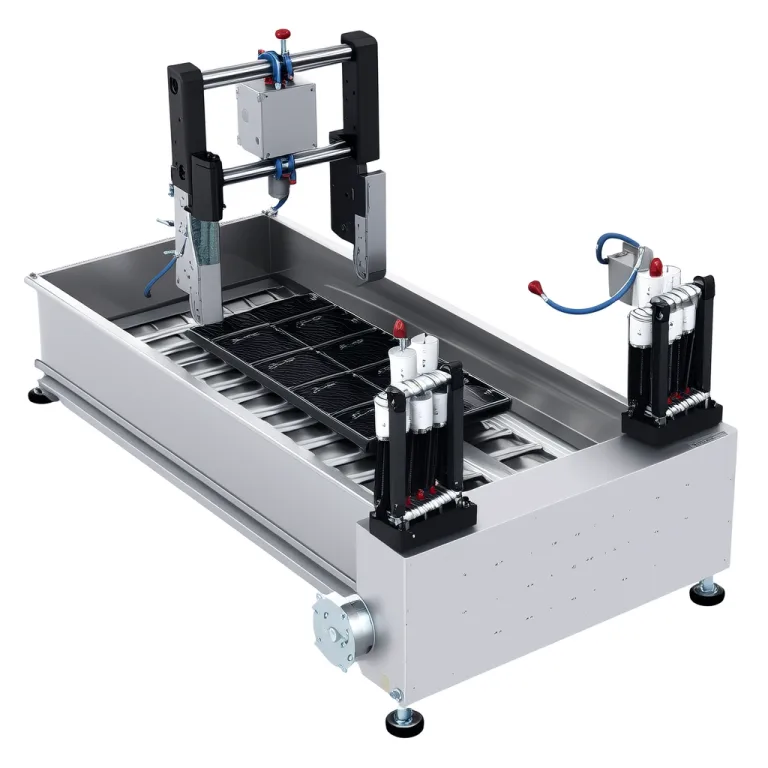
Battery Cell Stacking Machine
Battery Cell Stacking Machine for industrial applications.
About Battery Cell Stacking Machine
Battery Cell Stacking Machine for industrial applications.
| Domain | battery |
|---|
Who Works With Battery Cell Stacking Machine?
9 engineering roles are connected to Battery Cell Stacking Machine based on verified research evidence.
Service Engineer
Machine Operator
This is a formally recognized U.S. Department of Labor (O*NET/CareerOneStop) occupational title. While broad in scope (covering cutting, punching, and pressing), the evidence explicitly links it to plasma cutting equipment — including the specified DECAPOWER CUT series and CUT80 Air CNC Plasma Cutter Torch. Within the welding/cutting domain, these workers directly operate, monitor, inspect, and troubleshoot plasma cutting machines. 'Machine Operator' is the canonical, generalized professional role; 'Metal Cutting' is a valid functional specialization (not product-specific over-specification) because plasma cutting falls under metal cutting machinery operations.
PLC Programmer
PLC Programmer is a widely recognized professional role in industrial automation engineering, responsible for developing, debugging, and maintaining control logic for machines like the Battery Cell Stacking Machine. The evidence explicitly links PLC programming to the product’s functionality (e.g., motion control, sequencing, safety interlocks), confirming direct involvement in design, commissioning, troubleshooting, and maintenance.
Maintenance Technician
Calibration Technician
Calibration Technician is a widely recognized, standardized industrial role—especially in instrumentation and control domains. In the context of pressure transmitters (electrical/industrial instrumentation), this role directly performs calibration, functional verification, troubleshooting, and preventive maintenance per industry practice (e.g., ISA-84, IEC 61511, and manufacturer maintenance guidelines). The role is not product-specific (i.e., not 'Pressure Transmitter Calibration Technician'), so canonical form remains general. Evidence confirms emphasis on calibration and troubleshooting of pressure instrumentation.
Engineer
Process Engineer
Beverage Process Engineer is a recognized engineering role specializing in process design, validation, and compliance for beverage manufacturing systems. While 'Beverage' denotes industry context (not product-specific specialization), the role directly engages with ribbon blenders — particularly in specification, commissioning (including IQ/OQ), CIP/SIP integration, and 3-A sanitary validation — all cited in job listings. 'Process Engineer' is the canonical, general professional title; 'Beverage' reflects domain application, not an inseparable part of the core role definition.
Manufacturing Engineer
‘Battery Manufacturing Engineer – Cell Stacking Process’ denotes a specialized engineering role focused on the design, validation, and support of battery cell stacking processes — directly relevant to the Battery Cell Stacking Machine. While ‘Battery Manufacturing Engineer’ is not a standalone ABET- or IEEE-standardized title, it is a widely recognized industry-specific variant of Manufacturing Engineer (as evidenced by usage in Energy Storage Association contexts). The hyphenated modifier ‘Cell Stacking Process’ indicates process-specific focus, not a distinct profession; thus canonical_role is generalized to ‘Manufacturing Engineer’, with specialization capturing the domain and process. This role engages with the machine across its lifecycle: designing integration requirements, specifying process parameters, commissioning line integration, troubleshooting stack defects, and supporting maintenance protocols.
Validation Technician
The term denotes a technical role focused on verifying correct electrode alignment — a critical quality and functional check during commissioning and operation of battery cell stacking machines. 'Validation Technician' is a widely recognized role in manufacturing and automation; the prefix 'Electrode alignment' specifies the domain-relevant test scope but does not constitute a standalone profession. Evidence confirms this activity is part of system calibration and validation workflows (vision system calibration, electrode alignment validation) tied to the machine's performance.